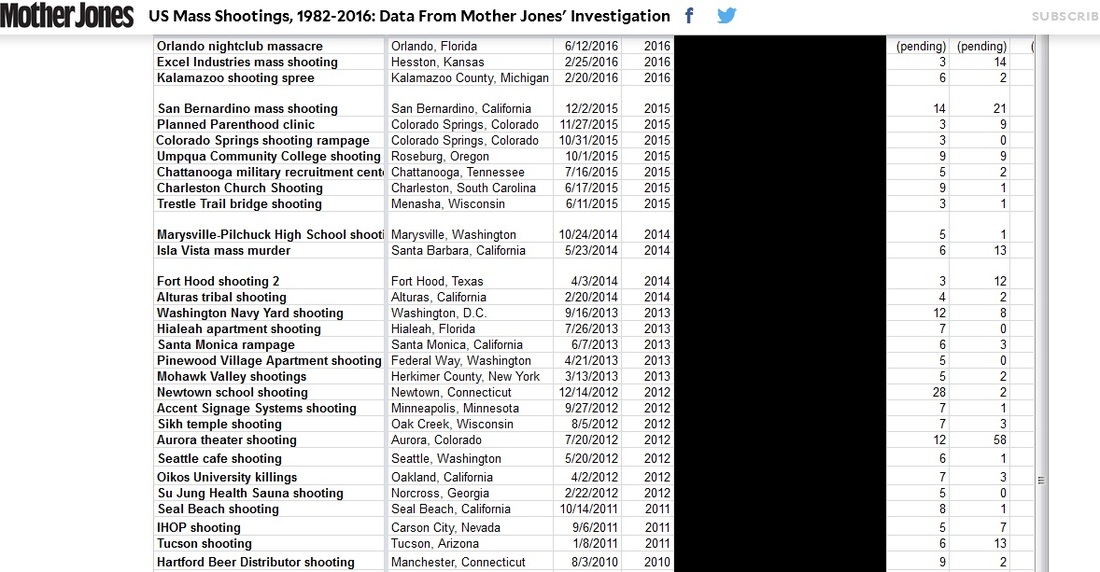
 Source: http://www.motherjones.com/politics/2012/12/mass-shootings-mother-jones-full-data America. Enough is enough. You have a problem. In the current political climate, the emphasis on Daesh/and radical Islam is popular among conservatives. They point to this as being the biggest threat to homeland security. While I'm not about to say that America doesn't have its enemies who would wish it harm, the statistics suggest that America's biggest problem is with Americans themselves. Particularly those with guns. From the outside looking in, it's easy to conflate the two issues. Do Americans carry guns to protect themselves from outwardly threats, or do they do it to protect themselves from each other? The above screen shot is taken from Mother Jones, which has a running total of the casualties of mass shootings in the United States. I stopped at 2011, but it's a list that unfortunately goes way back. The statistics suggest that guns are a domestic issue. In 2010, 67% of all homicides were committed with a gun. Despite the ridiculous statistics to the contrary, America doesn't want to see it has a problem with gun control. Certain segments of the population believe that constitutional amendments - among them the right to bear arms - are givens that are not up for debate. Let's talk about that right to bear arms for a second. Statistics suggest anywhere up to 1 in 3 Americans own a gun. Compare that to somewhere like Israel - where gun ownership is deemed a privilege - not a right - and the percentage of gun owners is less than 3% overall. In the US, the right to own guns is not limited to pistols. We're talking about a range of weapons which no citizen anywhere in the world has any business owning. We're talking about artillery that some troops around the world don't even have access to, but that can be bought in the United States and legally owned, as was the case with the Orlando shooter. Above and beyond America's insistence of protecting its constitutional right to bear arms [and presumably magazine style weaponry falls into this category] - despite the ridiculous statistics that beg action to the contrary - there are powerful voices who see the banning of Islam as being more productive than the banning of weapons. Australia's Mass Shootings and lessons learned I'm Australian, and was in Australia when two events that have largely shaped Australian minds and policy took place. Sadly, like many Australians, I was able to watch these events unfold from the safety of my living room. The first event was the so called Port Arthur Massacre which took place in 1996. In a sleepy ex prison colony, which was also one of the state of Tasmania's key tourist attractions, a lone gun man - with a history of psychiatric and mental illness - opened fire and over the course of a few hours killed 35 people (including children) and wounded dozens more. That event forced Australians and the Australian government to reflect on gun laws, which, until then, while regulated, reflected the right of people to own guns. The Australian government of the time, despite opposition from some organisations and parts of the community, passed new, stricter and sterner gun ownership laws, outlawing and restricting the ownership of more powerful guns such as rifles. Part of the process involved an amnesty in which people were encouraged to surrender their arms (legal or otherwise) without the fear of legal consequences. Despite opposition from conservatives, and from organizations - as far afield as the US' own NRA - the gun laws and amnesty have proven to be a huge success in Australia. While the efforts of lone gun men, or organized crime can never be fully avoided - the state's aim of safeguarding its citizens from people who have no logical need of access to weapons of these kinds, has largely helped Australia curb any further mass shootings from taking place. 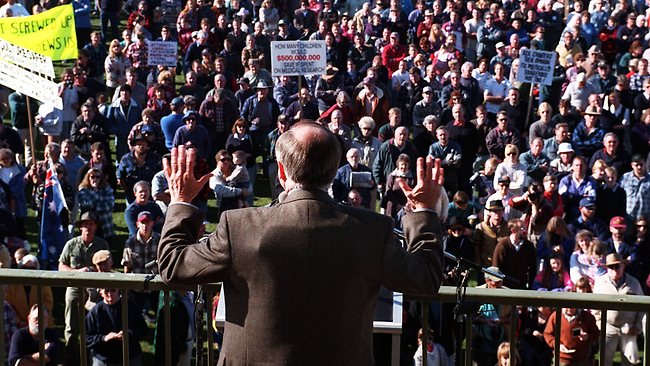 Former Australian PM John Howard confronting a pro-gun rally. Source: news.com.au I'm not a fan of our former prime minister. As a conservative, he cynically used his powers to change the definitions of marriage in his final years as PM so that they explicitly stated that marriage was a contract between men and women, an act which has slowed Australia's pace towards equality - and relegated it one of the last Western nations that doesn't recognise same sex unions. What I will acknowledge - as evidenced in this picture (wearing a bullet proof vest under his suit) - is that he took on the gun lobby and won. That's not to say that a change in gun laws will eliminate events like Orlando completely. After all, as recently as late 2014, a lone wolf shooter - with a documented history of mental illness - held eighteen people hostage in a cafe in Sydney. It was an event that shocked Australia, and that similarly involved the independent gun man pledging allegiance to Daesh. The gunman in this case had also been on a watch list at some time prior to the December hostage event. But, although recent, it's an isolated event. The carnage of mass shootings in Australia has largely been mitigated until now through the stricter approach to gun control, and in particular, the kinds of guns that are made available to those who insist on owning them. Would stronger, more coherent gun laws, similar to those in Australia have minimized the impact of the Orlando killer? I think we all know that the result could've been different, but that more importantly, the frequency with which these events seem to take place in the States can be reduced significantly. Revoking the Orlando killer's or anyone else's access to the kinds of weapons might not have stopped the killings from taking place, but I would say that the death toll would have to have been lower and that law enforcement may have had a better chance in controlling the situation and ultimately saving more lives. So, instead of a blind, rabid insistence on protecting your second amendment, why not reflect for a moment. Why not start with restricting and banning certain types of weapons? I get that some parts of your country are not that good with change - however logical. But don't you think that the victims in Orlando, and the other 28 mass shootings in the last five years alone deserve at least that? 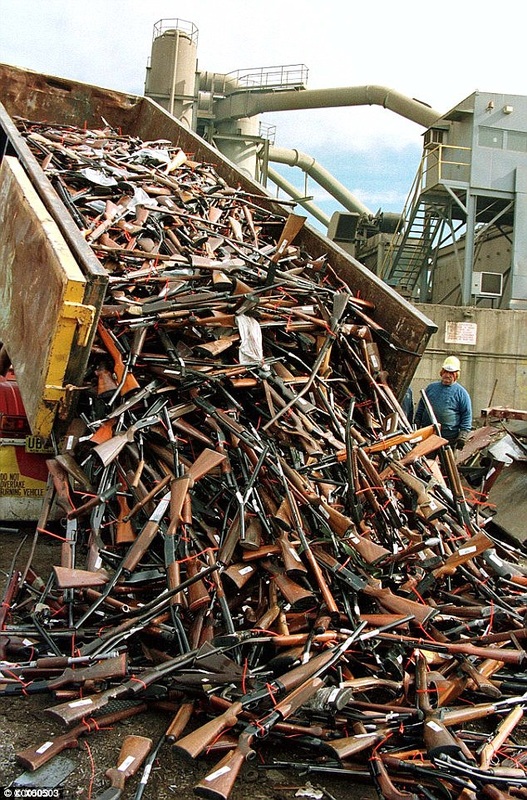 Prohibited weapons being unloaded and destroyed in Australia in 1997 as a result of a gun amnesty that took place. Source: dailymail.com
0 Comments
Your comment will be posted after it is approved.
Leave a Reply. |
Dave
|




 RSS Feed